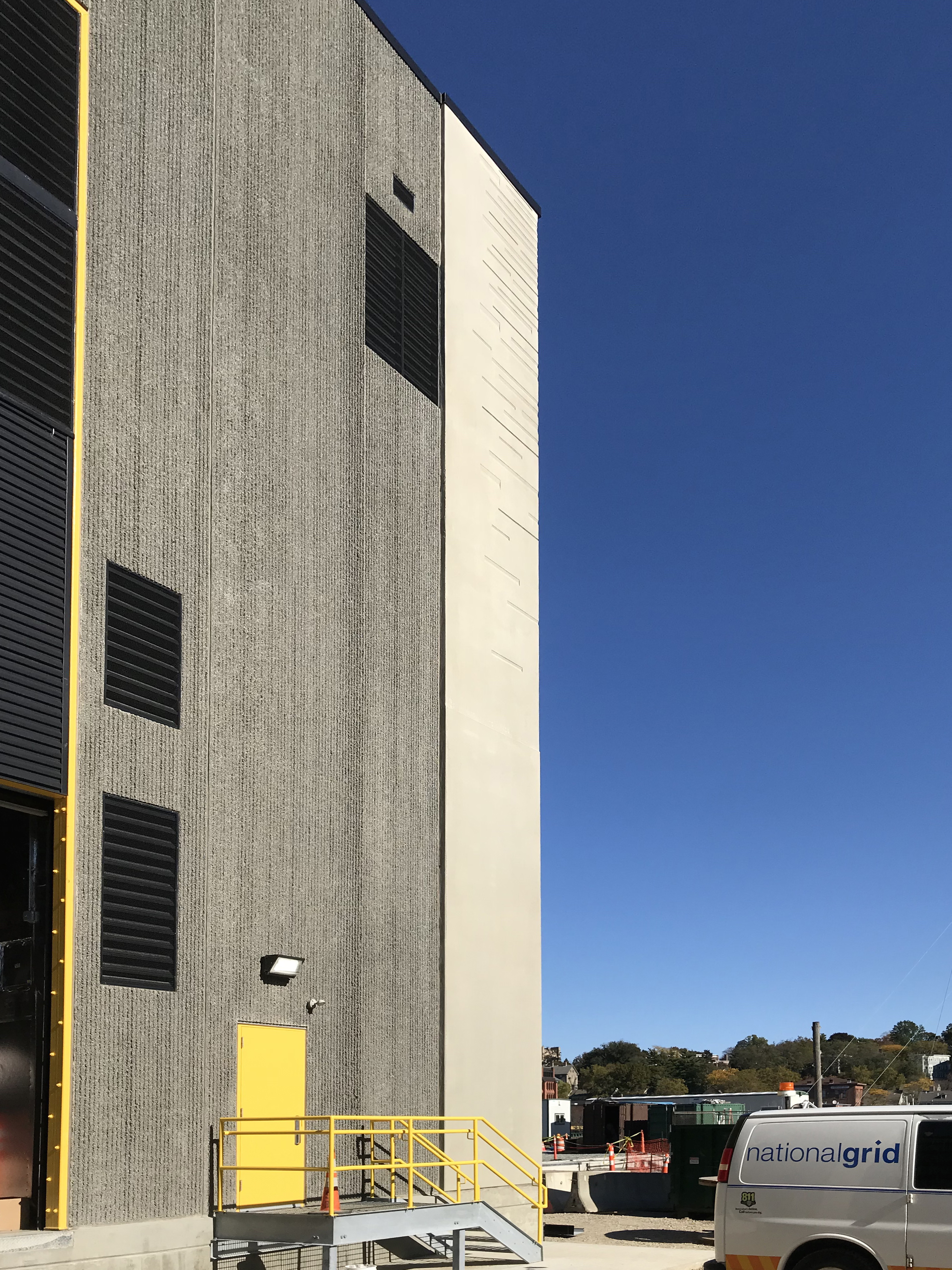
KITE is proud to be part of a new a key component in the reliable delivery of electricity to downtown Providence and the future of the I-195 Redevelopment Project. National Grid has broken ground on a new electric substation to replace the existing South Street substation, which dates back to the 1920’s. In addition to supporting National Grid’s current Providence customers, the substation is an essential element to the growth of the I-195 redevelopment district, including the first approved private project for these parcels, also by KITE.
The project includes building to house the substation along with outdoor switching equipment. The facility will be located behind the South Street Landing parking garage which is currently under construction and will be adjacent to the Providence River. National Grid has included a 20 foot wide public walkway along the river in the proposal.
KITE has worked closely with the engineering team led by TRC to develop a design that is appropriate for the visible site adjacent to the Providence River, planned parks, and the forthcoming pedestrian bridge. Working with materials that are both robust and frugal, the exterior includes detailing that recalls interference waves as a nod to the physics of electricity, and to form a subtle pattern from the viewable distance. The composition of required elements such as vents, louvers, and observation windows has been carefully controlled to create an elegant home for this important piece of infrastructure.
Why Lightning Roulette Outcomes Feel Suspicious: A Casimatic Breakdown
Lightning Roulette, developed by Evolution Gaming and launched in 2018, sits in a peculiar position among live casino games. It draws enormous player volumes, generates some of the highest engagement metrics in the live dealer category, and yet produces a steady stream of frustrated players who are convinced something is wrong with the results. The suspicion is understandable on the surface — the game’s multipliers, which can reach 500x on lucky numbers, seem to appear for everyone else but never for you. Before attributing this to manipulation, it is worth understanding exactly how the game is structured, where the math actually sits, and why human perception of randomness is so reliably poor at evaluating outcomes over short sessions.
How Lightning Roulette Is Actually Built — The Math Behind the Format
Standard European Roulette carries a house edge of 2.70%, derived from the single zero on a 37-pocket wheel. Lightning Roulette keeps the same physical wheel and the same random number generation process, but it restructures the payout table in a way that dramatically shifts the expected value calculation. Each round, between one and five numbers are randomly selected as “Lightning Numbers” and assigned multipliers of 50x, 100x, 200x, 300x, 400x, or 500x. To fund these enhanced payouts, the standard straight-up bet payout is reduced from 35:1 to 29:1 across all non-lightning numbers.
This reduction is not cosmetic. On a standard wheel, a straight-up bet returns 35 units on a 1-unit stake, giving a return-to-player (RTP) of 97.30%. In Lightning Roulette, the base payout drops to 29:1, which on its own would produce an RTP of approximately 81.08% — a catastrophically low figure for any casino game. The multipliers are added back on top of this to restore the theoretical RTP to approximately 97.10%, which is close to but slightly below the European standard. Evolution has published these figures, and independent testing laboratories including eCOGRA and Gaming Laboratories International have verified them.
What this means in practice is that the game has a slightly higher house edge than standard European Roulette, but the variance is dramatically increased. You are essentially playing a game where most sessions will feel worse than standard roulette because the base payout is lower, but occasional sessions involving multiplier hits will produce outsized returns. Players who never hit a multiplier — which is statistically common over short sessions — experience a game that pays out less than even a basic American Roulette wheel. This is the structural source of the suspicion, not any manipulation of outcomes.
Why the Results Feel Rigged: Cognitive Biases in Action
The human brain is not equipped to evaluate probabilistic outcomes accurately, particularly in environments designed to maximize emotional engagement. Lightning Roulette’s production design — the dramatic lightning strikes, the animated multiplier reveals, the presenter’s reactions — is engineered to make multiplier hits feel significant and memorable. This amplifies a well-documented cognitive phenomenon called the availability heuristic: events that are emotionally vivid are recalled more easily and therefore perceived as more frequent than they actually are.
When another player at the table hits a 500x multiplier and the screen fills with animations, that moment is encoded deeply. When you receive a standard 29:1 payout on the same number, it registers as a near-miss or a loss of potential. Over dozens of sessions, the memory is populated with other people’s multiplier wins and your own base-rate returns, which creates a subjective impression that the multipliers are being distributed unfairly. They are not — every player at the virtual table is seeing the same Lightning Numbers each round, and the selection process is independent of individual bets.
A related bias is outcome attribution asymmetry. Wins tend to be attributed to skill or good timing; losses and missed multipliers are attributed to external causes including rigging, bad luck streaks, or the casino targeting specific accounts. This asymmetry is well-documented in behavioral economics research going back to Kahneman and Tversky’s foundational work in the 1970s and 1980s. In the context of online gambling, it manifests as a persistent belief that the system is working against the individual player specifically, rather than simply producing outcomes within its stated probability distribution.
For a detailed examination of how these perceptions develop and what the data actually shows about session outcomes, the analysis at http://casimatic.org/lightning-roulette-rigged-am-unlucky/ breaks down the statistical patterns that distinguish genuine variance from anomalous results, which is a useful reference for players trying to evaluate their own experience objectively.
Regulatory Oversight and What It Actually Guarantees
Evolution Gaming holds licenses from the Malta Gaming Authority, the UK Gambling Commission, and several other jurisdictions. These are not nominal approvals — they require ongoing submission of game mathematics documentation, RNG certification from accredited third-party laboratories, and regular audits of live game infrastructure. The UK Gambling Commission in particular has enforcement powers that have resulted in fines exceeding £100 million against major operators since 2017, demonstrating that the regulatory framework has real teeth.
The RNG used in Lightning Roulette’s multiplier selection process is certified to produce outcomes that are statistically independent across rounds. This means the probability of a specific number being selected as a Lightning Number does not change based on how long it has been since it was last selected, how much money is currently bet on it, or any other game-state variable. This certification is renewed periodically and is a condition of operating in regulated markets.
It is worth being precise about what regulation does and does not guarantee. It guarantees that the game operates according to its published mathematics and that outcomes are not manipulated in real time. It does not guarantee that any individual player will experience results consistent with the theoretical RTP over a short session. A game with a 97.10% RTP can produce a session where a player loses 40% of their bankroll — this is within the normal distribution of outcomes for a high-variance game. Regulation addresses systematic manipulation; it cannot and does not address variance.
Casimatic has noted in its analysis of live casino products that player complaints about Lightning Roulette cluster heavily around sessions of fewer than 200 rounds, which is far too small a sample to draw conclusions about whether a game is performing within its stated parameters. Professional game analysts typically require thousands of rounds before making any assessment of RTP deviation, and even then, the confidence intervals are wide.
The Practical Reality of Playing High-Variance Live Casino Games
Understanding the structure of Lightning Roulette changes how a player should approach session management. Because the base payout on straight-up bets is 29:1 rather than 35:1, a player who never hits a multiplier is effectively playing a game with a house edge of approximately 18.9% on those bets. This is not a sustainable position over any meaningful number of sessions. The game’s expected value only approaches its published 97.10% RTP when multiplier hits are factored into the calculation across a large sample.
This creates a practical asymmetry that affects nearly every player. Short sessions without multiplier hits feel significantly worse than standard roulette because they are, mathematically, worse in terms of base payout. Players who understand this going in are less likely to interpret a bad session as evidence of manipulation — they recognize it as the expected outcome for a session that did not include the high-value events the game is built around.
Evolution has expanded the Lightning format into other games since the original Lightning Roulette launch, including Lightning Baccarat and Lightning Dice, all of which use the same structural logic: reduce base payouts and introduce random multipliers to increase variance and perceived excitement. The pattern is consistent and the mathematics are published. Casimatic’s coverage of these products consistently emphasizes the importance of understanding the base payout reduction before evaluating session results, which is the single most important piece of information a player can have before sitting down at any Lightning-format game.
Lightning Roulette outcomes feel suspicious because the game is designed to produce a wide distribution of results, the base payout is lower than most players realize, and human memory disproportionately records other players’ multiplier wins relative to one’s own base-rate returns. None of this constitutes evidence of manipulation. The game operates under verified regulatory oversight, its mathematics are publicly available and independently certified, and the pattern of player complaints maps almost perfectly onto what behavioral research would predict for a high-variance product in an emotionally engaging presentation format. The most accurate frame for evaluating any session of Lightning Roulette is not whether the results feel fair, but whether you understood the payout structure before you started playing.